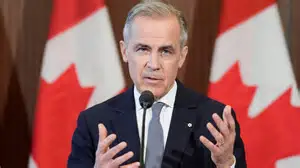
When Canadian Prime Minister Mark Carney landed in Sydney on Tuesday morning and stepped off the government aircraft alongside his wife Diana Fox Carney, he was met by a delegation of Australian officials and a diplomatic schedule packed from the first hour. Business meetings in Sydney. A keynote at the Lowy Institute. Then Canberra — where on Thursday he addressed the Australian Parliament and became only the second Canadian prime minister in history to do so, the first since 2007.
It was a deliberately crafted visit, designed to signal something specific: Canada and Australia, two middle powers with similar economies, similar political institutions and a shared inheritance from the same democratic tradition, are choosing to invest in each other at a moment when the old global order is fracturing and reliable partnerships are more valuable than at any point in a generation.

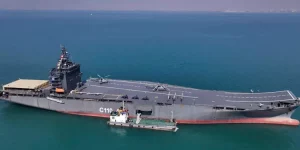
The timing, as Carney acknowledged obliquely, was not incidental. The Iran war. The Middle East in flames. Trade tensions with the United States. China’s growing assertiveness in the Indo-Pacific. A global economy unsettled by energy price shocks. In that context, a Canadian prime minister flying to Canberra is not just a diplomatic courtesy call. It is a statement.
The relationship behind the visit
Carney and Albanese first met at Pope Francis’s funeral in Rome in 2025. According to officials from both governments, they developed what was described as a genuine personal connection — a rare thing in the transactional world of international diplomacy — that has made moving quickly on practical cooperation considerably easier.
Australian Opposition leader Angus Taylor, who studied alongside Carney at Oxford University, welcomed the visit warmly on the floor of Parliament, recalling sharing “tinnies” with Carney during their student days and describing him as “a man of the highest calibre.” The bipartisan enthusiasm was unusual — and meaningful for a week in which most of Australian politics was consumed by the crisis in the Middle East and the AUKUS debate.
“One of life’s great joys is seeing old friends do well,” Taylor said from the Opposition benches. “In this brave new world, we must work together.”
Carney’s message: middle powers, unite
Carney arrived in Australia with a message he had been developing since his landmark speech at Davos in January. Its core argument: middle powers — countries like Australia, Canada, Japan, South Korea, and the European nations — have more collective weight than they realise, and they are squandering it by failing to coordinate.
He laid the argument out clearly at the Lowy Institute in Sydney on Wednesday, and again in his parliamentary address the following day. Europe, Australia, Canada, Japan and South Korea combined have a GDP larger than that of the United States. Together, they have three times the trade of China. “Middle powers have more power than many realise,” he told the Lowy audience.
“Australia and Canada can’t compel like the great powers, but we can convene, we can set the agenda, shape the rules and organise and build capacity through coalitions that deliver results at speed and global scale.”— PM Mark Carney, Lowy Institute, Sydney
In Parliament, he went further. Standing in the chamber where Australia’s laws are made, he told the assembled legislators that the world’s established institutional order was “breaking down” and that allies who shared the same democratic values had an obligation to draw closer together, not drift further apart.
“We may look to different skies — the North Star in our hemisphere, the Southern Cross in yours — but we have the same orientation.”— PM Mark Carney, Australian Parliament
What was signed
The visit produced a substantive stack of agreements — not just declarations of intent, but signed deals with financial weight behind them.
Australia joined Canada’s Critical Minerals Production Alliance — an initiative Carney launched under Canada’s G7 Presidency in 2025 to build democratic supply chains for the minerals that semiconductors, defence systems and clean energy technologies all depend on. Canada and Australia together, Carney said, are building “the largest mineral reserve held by trusted democratic nations.”
A new Australia-Canada Clean Energy Partnership was signed, establishing cooperation on trade, investment, grid modernisation and supply chain resilience across clean energy sectors. Industry Funds Management, Australian superannuation funds and Canadian pension funds signed a Memorandum of Understanding to channel institutional capital into shared infrastructure priorities — with IFM announcing an intention to invest up to $10 billion in Canada.
Both countries committed to modernising the Canada-Australia Tax Treaty, which has not been updated in decades, to facilitate greater bilateral investment. The Business Councils of Australia and Canada signed their own MoU on trade facilitation. A new MoU on AI Safety was agreed, enabling greater collaboration between the two countries’ AI safety institutes. And Canada and Australia committed to a Status of Forces Agreement — a legal framework that would make it easier for military personnel from each country to operate on each other’s soil.
On defence specifically, Canadian Armed Forces personnel will begin training in Australia on the Arctic Over-the-Horizon Radar system from mid-2026 — a system Canada has already committed to purchasing for its own Arctic monitoring needs. The radar, developed in Australia, provides long-range airborne threat detection and forms a key part of Canada’s NORAD modernisation plans.
The geopolitical context
Everything about this visit was shaped by the broader moment in which it took place. Carney visited India immediately before arriving in Australia, and is heading to Japan when he leaves. The three-stop Asia-Pacific tour is not accidental in its sequencing: India, Australia and Japan are three of the countries whose alignment with democratic values and free-trade principles Carney considers essential to the alternative order he is trying to help build.
Canada has its own complicated relationship with the United States right now. “Seventy cents of every dollar we spend on defence goes to the United States,” Carney told business leaders in Sydney — presenting it not as a complaint but as a strategic vulnerability that both Canada and Australia have reason to address by building sovereign capability and allied partnerships that do not depend entirely on Washington’s goodwill.
Australia has been navigating a similar calculation for years: how to maintain the US alliance while also building genuine capability and genuine alternatives. The Carney visit suggests that calculation is now being made simultaneously, and in parallel, by countries that did not previously see each other as natural partners for that work.
Carney left for Japan on Thursday. He will be back. Both governments have committed to regular ministerial-level meetings going forward — something that has not previously been a feature of the Australia-Canada relationship. The visit, in that sense, was less an end point than a beginning.







Leave a Comment