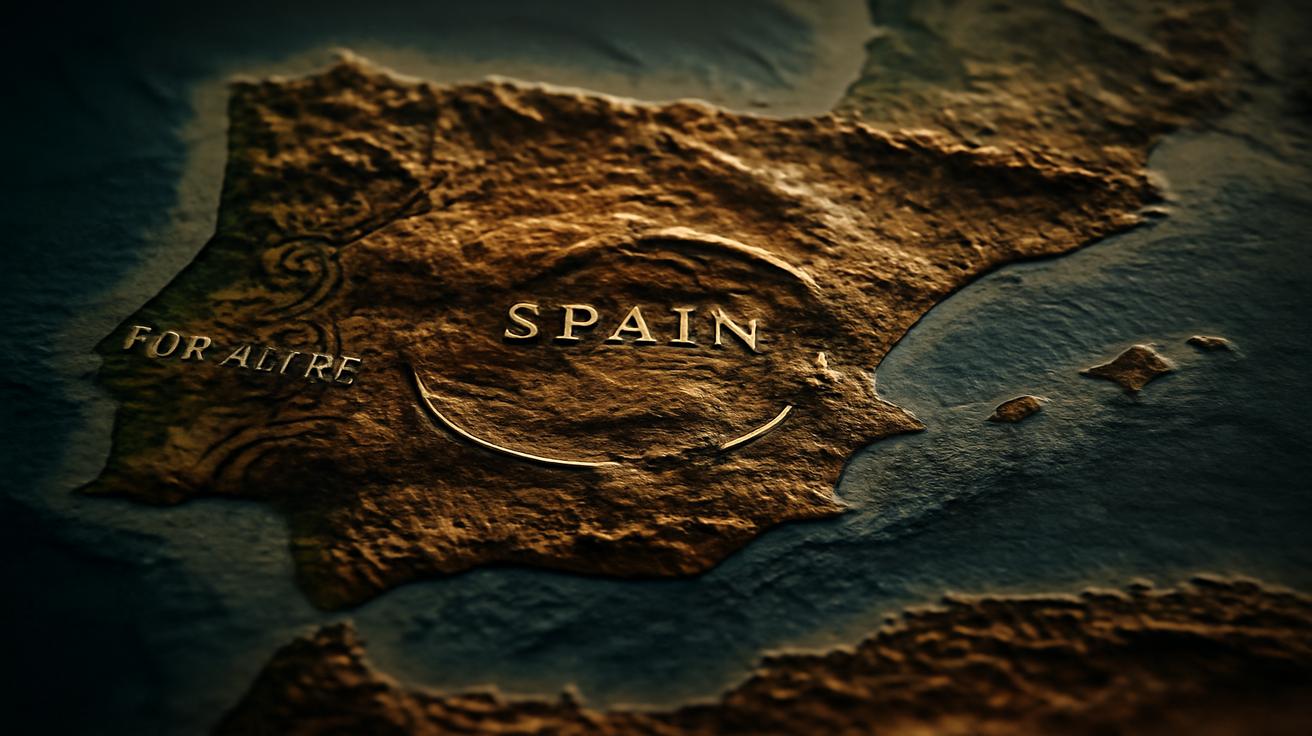
In a discovery that challenges our perception of geological stability, researchers have documented evidence that Portugal and Spain are engaged in an almost imperceptible rotational movement. This subtle shift in the Iberian Peninsula represents one of the more intriguing examples of active tectonics occurring within Europe, a continent often overshadowed by more dramatic seismic activity elsewhere on the planet.


The Nature of Continental Rotation
Geological processes operate on timescales that dwarf human perception. What might be imperceptible over a human lifetime becomes significant when viewed through the lens of millions of years. The rotation of the Iberian Peninsula falls squarely into this category—a glacially slow dance of crustal material that speaks to the dynamic nature of Earth’s interior.
The movement detected by geologists involves a clockwise rotation when viewed from above, with the peninsula gradually pivoting around a theoretical central axis. This rotation is not uniform across the entire landmass; rather, it represents differential movement influenced by the complex system of faults, stress fields, and plate boundaries that characterize the region.
Understanding the Mechanisms Behind the Movement
The driving force behind this geological phenomenon lies in the interplay between the African and Eurasian tectonic plates. The collision zone between these two massive crustal segments has been shaping the Mediterranean region for tens of millions of years. Unlike the more spectacular plate boundaries found in places like California or Japan, the interaction between African and Eurasian plates in the Iberian Peninsula manifests as distributed strain across numerous fault systems rather than a single dominant boundary.
The actual rate of rotation measured by geologists is remarkably slow—measured in millimeters per year when expressed in linear terms. However, this gradual accumulation of movement over millions of years results in significant changes to the peninsula’s orientation. Paleomagnetic studies and GPS measurements have provided complementary evidence of this ongoing rotation, with modern satellite technology allowing scientists to track these movements with unprecedented precision.
The stress accumulated from this rotation process is released through periodic earthquakes, though most seismic events in the Iberian Peninsula remain relatively modest compared to those in more active tectonic zones. This distributed strain release over numerous smaller earthquakes is generally preferable to the accumulation of stress that would result in catastrophic seismic events.
Scientific Methods and Detection
The discovery of the Iberian Peninsula’s rotation stems from multiple lines of geological evidence. GPS networks established across Spain and Portugal provide direct measurements of crustal movement, with continuous monitoring stations recording minute displacements over time. These measurements, collected over years and decades, reveal consistent patterns of motion compatible with a slow rotation.
Geological fault mapping and kinematic analysis of fault movements provide additional evidence. By examining the direction and magnitude of displacement along major fault systems, scientists can reconstruct the stress field and infer the rotational component of regional deformation. The orientation of focal mechanisms from earthquakes across the peninsula further supports the rotational model.
Paleomagnetic studies examining magnetization patterns in rocks provide historical perspective on crustal rotations. These studies reveal that the current rotation represents a continuation of long-standing tectonic processes rather than a new phenomenon. The consistency between paleomagnetic evidence and modern instrumental measurements strengthens confidence in the rotational interpretation.
Regional Implications and Geological Consequences
This rotational movement has profound implications for understanding the evolution of the Iberian Peninsula. The rotation influences how stress is distributed across the region, affecting earthquake hazard patterns, mountain building processes, and crustal thickness variations. The complex topography of the peninsula—with the Central Spanish Plateau, the Pyrenees, and the Cordillera Cantabrica—reflects the cumulative effects of this rotational deformation combined with other tectonic processes.
The rotation also plays a role in shaping the peninsula’s geological structure at depth. Different regions experience varying amounts of vertical crustal movement as a consequence of the rotation, leading to variable subsidence and uplift patterns. This, in turn, influences the distribution of sedimentary basins and the pathways for fluid migration in the crust.
Comparative Tectonics: Placing Iberia in Global Context
While continental rotation might seem unusual, it represents a recognized phenomenon in plate tectonics. The Iberian Peninsula joins other regions worldwide where similar rotational movements have been documented or inferred. Australia, portions of Southeast Asia, and other continental margins all exhibit rotational deformation as plates interact and accommodate stress.
What makes the Iberian case particularly interesting to geologists is the relatively straightforward geometry of the driving forces—primarily the Africa-Eurasia plate convergence—combined with excellent data coverage. This makes the peninsula an ideal natural laboratory for studying continental rotation mechanics and testing models of lithospheric deformation.
Future Research Directions
Ongoing research continues to refine our understanding of the Iberian Peninsula’s rotational dynamics. Enhanced GPS networks and advancing satellite interferometry techniques provide ever-greater precision in measuring crustal movements. These technological improvements allow scientists to distinguish between different potential mechanisms driving the rotation and to better constrain the stress fields involved.
Future studies will likely incorporate three-dimensional modeling of the crustal structure and stress distribution, integrated with seismic data to create comprehensive models of deformation. Such integrated approaches promise deeper insights into how continents respond to plate boundary forces and how strain is accommodated through large-scale rotations and distributed faulting.
Implications for Seismic Hazard Assessment
Understanding the rotational component of Iberian tectonics carries important implications for earthquake hazard assessment. The stress field induced by rotation influences which faults are most likely to rupture and under what conditions. This information proves valuable for urban planning and infrastructure development in populated regions of Spain and Portugal, where earthquake risk remains an important consideration despite the region’s moderate seismic activity relative to other parts of the world.
The discovery that Portugal and Spain are slowly rotating on themselves stands as a reminder of our planet’s dynamic nature. Geological processes operate across vast timescales and spatial scales, reshaping the continents we inhabit through imperceptible movements that accumulate into dramatic changes. The Iberian Peninsula’s slow rotation exemplifies how modern geological science reveals the hidden dance of Earth’s crustal material, granting us deeper appreciation for the forces that have sculpted our world across geological history.










Leave a Comment