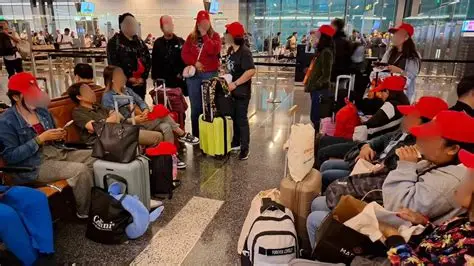
The flights are coming. Not enough of them, and not fast enough for tens of thousands of Australians still waiting — but they are coming. Emirates from Dubai. Etihad from Abu Dhabi. Rows and rows of seats that stranded Australians would give almost anything to fill.
And yet, as of this week, hundreds of those seats are going empty on every departure.


The revelation emerged mid-week and prompted one of the more unusual pieces of government communication in a week already full of unusual things. Foreign Minister Penny Wong, who has handled an extraordinarily difficult consular crisis with relative composure, told reporters she was “disappointed” — and made a direct, personal appeal to every Australian who had a seat booked on a repatriation flight: if you are leaving, let the airline know. And if your plans have changed and you are getting home another way, please cancel your booking.
“We want every seat filled,” she said. “Every empty seat is a seat another Australian can’t take.”
How did this happen?
Understanding the empty seats problem requires understanding the conditions that created it. When the conflict erupted and airspace began closing in rapid succession on the last weekend of February, the window of possibility for Australians trying to secure seats home narrowed from days to hours. Bookings that were confirmed one hour were cancelled the next as airlines updated their operations. Passengers holding tickets for cancelled flights were told to rebook, but the rebooked flights were also being cancelled.
In that environment, booking multiple flights simultaneously — or accepting a seat on the first available option and not cancelling the others — was not irrational. It was the rational response to a situation where the only way to guarantee getting home was to hold multiple options at once and see which one actually departed.
The result, as the situation began to stabilise and the UAE resumed partial flight operations from Tuesday onwards, was manifests full of names but planes with empty rows. Passengers who had found overland routes through Oman or Saudi Arabia. Passengers who had taken seats on connecting flights through other hubs that cleared before their booked repatriation departure. Passengers who had simply stopped receiving emails because they had changed hotels and their contact details with the airline were out of date.
Aviation tracking data confirmed that more than 2,000 flights to and from major Gulf airports had been cancelled across the region in just the first two days of the conflict. Rescheduling that volume of disruption — matching revised manifests to actual passengers in real time, across multiple carriers, in a partially closed airspace — is logistically complex even under normal circumstances. In the middle of a regional war, it is close to impossible without detailed coordination between airlines, governments and passengers.
What the government is doing about it
Wong announced that DFAT would work more closely with airlines to coordinate seat allocation going forward. The specific mechanism — how to match actual departure intentions to confirmed bookings in real time — has not been publicly detailed, but officials have indicated it involves closer integration between the DFAT crisis portal registration data and airline passenger management systems.
Six DFAT Crisis Response Teams are now on the ground across the region — in Dubai, Abu Dhabi, Doha (where Australian officials are present despite Qatari airspace remaining closed), Israel, and Oman. Their role includes helping to identify and prioritise the most vulnerable Australians for available seats: elderly travellers, people with medical conditions, pregnant women, and those with young children.
Abu Dhabi has been added as a new departure hub for the first time, giving stranded Australians in the UAE a second point of departure beyond Dubai. Government-facilitated flights are coordinating with Emirates and Etihad. Four flights had departed the region carrying Australians by the end of the week, with four more planned in the following 24 hours of Wong’s statement.
Two military aircraft — a C-17A Globemaster and a KC-30A Multi-Role Tanker Transport — remain positioned in the region for contingency evacuation use if commercial options become insufficient. The government has declined to specify where those aircraft are based for security reasons.
The voices from the ground
Lucy Kenyon was among the 230-plus Australians on the first Emirates flight to land at Sydney Airport on Wednesday night. She described the mood on the aircraft shifting palpably as the plane approached Australia. “Once you knew you were out of the danger zone, you could feel the mood lift,” she said. “Everyone clapped when we landed and so it was really good.”
Others were less fortunate in their timing. An Australian man living in Dubai who spoke to SBS News — requesting anonymity because he said residents were being warned about fines for publicly discussing Iranian attacks — described watching missiles pass over his building and said the silence from Australian authorities in the early days had been deeply unsettling. “The silence is deafening,” he said. “The US has alerted all expats to leave the region. While calling the Australian embassy, we’ve been told to wait for advice.”
The criticism of the government’s early communication has been consistent from multiple sources. Opposition foreign affairs spokesman Ted O’Brien described the response in the first 48 hours as “amateur hour.” The government maintains that, given the unprecedented scale of the crisis and the practical constraints created by closed airspace, its response has been as fast as circumstances permitted.
What stranded Australians need to do right now
If you or someone you know is currently stranded anywhere in the Middle East, the steps are clear. Register through the emergency crisis portal at smartraveller.gov.au — or update your registration if you have moved since you first registered. This is the primary mechanism through which DFAT’s crisis teams identify and prioritise Australians who need assistance.
Do not cancel a booked flight without first contacting the airline. Under applicable consumer law, a flight cancellation triggered by the airline entitles you to a refund or rebooking. But if you cancel voluntarily — even because you think you have found another way home — you may lose those entitlements. Speak to the airline first.
If you are in Israel, Iran, Qatar or Bahrain and need emergency consular assistance that you cannot access through the standard embassy contact, call the 24-hour Consular Emergency Centre: +61 2 6261 3305 from overseas, or 1300 555 135 from inside Australia. The centre is staffed around the clock.
Smartraveller now advises Australians against travel to Bahrain, Israel, Kuwait, Lebanon, Qatar and the United Arab Emirates. If you are in any of those countries, the advice is to limit your movements, stay in a safe location, follow the instructions of local authorities, and make plans to leave when it is safe to do so.
Penny Wong has said the government will not leave any Australian behind. How quickly the queue moves depends on how quickly the region’s airspace continues to open — and on every Australian holding their seat, staying in contact with their airline, and doing their part to make sure those hundreds of empty seats stay full.
The flights are coming. They just need Australians to be on them.











Leave a Comment