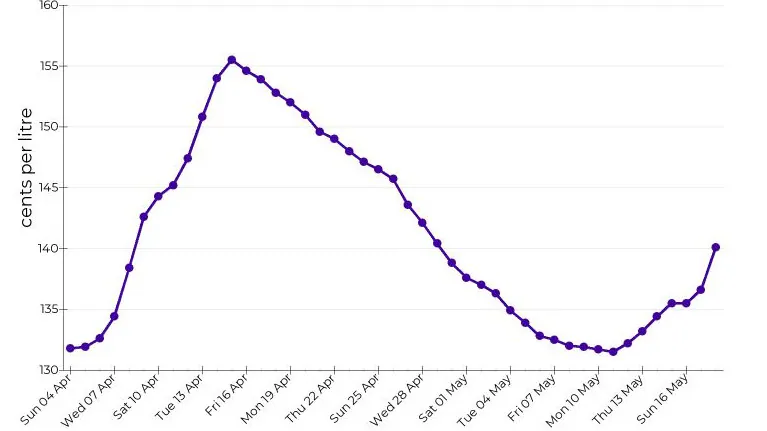
On Monday this week, the average price of regular unleaded petrol in Sydney was 201.8 cents a litre, according to the NRMA. By Tuesday it had climbed. By Wednesday, some stations in the inner city were displaying 220 cents. Long queues began forming at petrol stations across Sydney and Melbourne — some driven by genuine worry, others by the particular anxiety that comes when something you can see and measure starts moving in the wrong direction in real time.
The Iran war has arrived at the petrol pump. And the people whose job it is to model these things for a living say this may be only the beginning.


The Strait of Hormuz — a narrow passage of water between Iran and Oman, barely 33 kilometres wide at its tightest point — has effectively closed. Through it normally flows approximately 20 per cent of the world’s seaborne oil, and nearly a fifth of global liquefied natural gas supply. When Iran threatened to destroy any vessel attempting passage, most shipping companies stopped sending vessels. Marine tracking platform MarineTraffic recorded a 70 per cent drop in vessel traffic through the strait within days of the conflict beginning.
The numbers flowed immediately into global oil markets. Brent Crude — the international benchmark price — surged. Goldman Sachs estimated traders were demanding around $14 more per barrel than before the conflict began to compensate for the elevated risk. Australia, which imports roughly 90 per cent of its liquid fuel, sat squarely in the path of every dollar of that increase.
Three scenarios, and what each means for you
Westpac’s economics team has laid out the situation in three scenarios, each more severe than the last.
In the first scenario — disruption of Iranian oil production only, without a prolonged Hormuz closure — oil could rise to around US$100 a barrel. At that level, Australians would likely pay around 25 cents more per litre at the pump. Uncomfortable, but manageable.
In the second scenario — a Hormuz closure lasting up to one month — Brent could spike to US$113 a barrel. That represents a rise of around 50 cents per litre. Westpac estimated a one-month disruption would lift Australia’s Consumer Price Index by around one percentage point, with GDP growth roughly 0.2 percentage points lower.
In the third and most severe scenario — a Hormuz closure lasting up to three months — oil could reach US$185 a barrel, according to Westpac. That translates to approximately $1 more per litre at the pump. For a 60-litre tank, filling up could cost around $24 more than it did a week ago. A three-month closure could temporarily spike the CPI by around 1.5 percentage points at its peak, with GDP 0.5 percentage points lower by the end of 2026.
AMP chief economist Shane Oliver went further, warning that a worst-case scenario in which the US becomes mired in a prolonged conflict could see oil prices double to around US$150 a barrel. Goldman Sachs estimated global oil prices could rise by $1 to $15 per barrel depending on the extent and duration of any Hormuz closure and whether spare pipeline capacity was utilised as a partial offset.
The widely accepted rule of thumb is that every US$10 increase in the price of a barrel of crude adds around 10 cents per litre at Australian bowsers. The NRMA has forecast prices at the petrol pump will increase by around 10 per cent in the near term, but has urged Australians not to panic. “Whatever happens overseas takes about seven to 10 days to flow on here at home,” NRMA spokesman Peter Khoury told journalists.
The Strait of Hormuz: why it matters so much
The Strait of Hormuz has been described as the world’s most critical energy chokepoint — and the description is not an exaggeration. The US Energy Information Administration estimated that in 2024, around 20 million barrels of oil a day flowed through the strait — roughly 20 per cent of global petroleum liquids consumption.
Saudi Arabia, Iraq and the UAE together export approximately 13.1 million barrels a day through the strait, with China as the primary destination. Some 30 per cent of Europe’s jet fuel originates from or transits via the strait. Approximately 20 per cent of global LNG supply passes through the waterway. At least five tankers have been damaged since hostilities began, with two personnel killed and around 150 ships stranded around the strait as of Friday.
QatarEnergy, operator of the world’s largest LNG export facility, halted activity after the facility was targeted in an Iranian drone attack. Saudi Aramco’s Ras Tanura facility — one of the world’s largest oil processing complexes — was hit and shut down. The combination of these disruptions pushed LNG prices up around 12 per cent since the conflict began.
What about Australia’s fuel reserves?
At the start of 2026, Australia held an estimated 36 days of petrol, 34 days of diesel and 32 days of jet fuel — the largest stockpile Australia has maintained in 15 years. Energy Minister Chris Bowen moved quickly to reassure the public that there was no immediate threat to fuel supplies. “I understand people’s concern, but it is important that people know we do have a good stock of petrol in reserve,” he told reporters.
But the reassurance comes with caveats. Australia’s fuel reserves are still technically “non-compliant” under International Energy Agency standards, which recommend a minimum of 90 days. They have been non-compliant since 2012. And Australia’s National Security Program director John Coyne has warned that if the Hormuz closure extended to five weeks, the effects on Australia’s mining and agricultural sectors — which are among the heaviest users of diesel in the country — could become significant. Iron ore mining in the Pilbara alone consumes hundreds of millions of litres of fuel per year.
Price gouging, the ACCC, and what you can do
The ACCC moved quickly. Commissioner Anna Brakey issued a public warning to fuel retailers that making false or misleading statements about the reasons for price increases would breach Australian consumer law, and that the regulator had already contacted major fuel companies about its expectations. “The ACCC will not hesitate to take action,” she said.
Queensland’s RACQ went further, referring several major fuel retailers to the ACCC for price jumps that occurred less than three days after the conflict began — jumps it described as unjustified given that global price movements take seven to ten days to reach Australian pumps. Treasurer Jim Chalmers also wrote formally to the ACCC asking it to monitor fuel prices and any instances of price gouging.
For consumers, the practical advice is to use fuel price comparison apps — GasBuddy, MotorMouth and the NRMA’s own app all track live prices — to find the lowest bowser price near you. Petrol prices vary significantly between stations in the same suburb. Shopping around is more valuable than it has been in years.
What this means for inflation and interest rates
Reserve Bank governor Michele Bullock told the AFR Business Summit that the central bank was modelling a number of scenarios on energy prices and their impact on the Australian economy and inflation. She acknowledged “real challenges” if the Hormuz closure persisted, but was careful to avoid creating the impression of certainty in either direction.
CBA’s economics team noted that a prolonged Middle East conflict could morph into a large demand shock for the global economy, and that if it did, “the balance of risks for the RBA could shift.” On current modelling, CBA expects the RBA to look through any short-term petrol price spike and continue anticipated rate movements — but acknowledged the calculus changes materially if the conflict continues beyond two to three months.
For now, the queues at petrol stations have begun to shorten. Panic buying has eased. But the war in Iran is not over, the Strait of Hormuz is not open, and the fuel that sits in Australian reserves today is finite. The next seven to ten days will tell us more about where this goes from here.










Leave a Comment