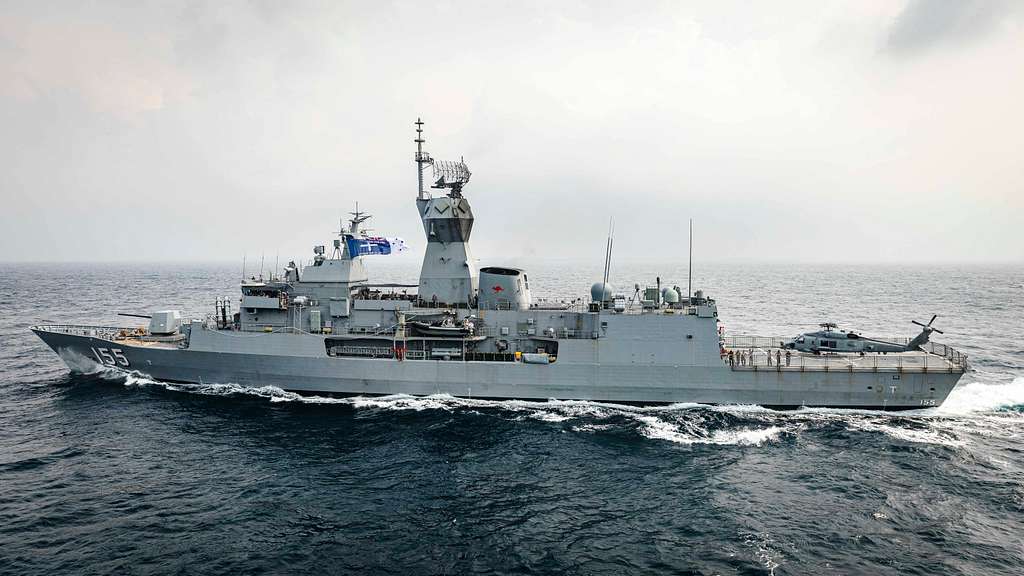
The ADF MH-60R helicopter crew had been going about their mission in the Yellow Sea — a routine day’s work during what had been a routine deployment — when the Chinese military helicopter closed in. It matched their altitude. It moved to what Australia’s Defence Ministry would later describe as an unsafe distance. Then it accelerated, moved slightly ahead of the Australian aircraft, and rolled toward it.
The Australian crew took immediate evasive action. Nobody was hurt. The aircraft was undamaged. But what happened in international airspace above the Yellow Sea on 4 March has triggered a formal diplomatic complaint to Beijing and reignited the sharpest debate Australia has had about China’s military behaviour in the region since the flares incident over the South China Sea.


The timing — with Australia already managing its position on the US-Iran war, 115,000 stranded citizens in the Middle East, and intense scrutiny of its AUKUS commitments — could hardly have been more fraught. And yet, here it was.
What happened in the Yellow Sea
HMAS Toowoomba is an Anzac-class frigate, 118 metres long, with a crew of around 180 sailors and a flight deck capable of operating embarked helicopters. On 4 March, the vessel was operating in international waters in the Yellow Sea — a stretch of ocean between China, the Korean Peninsula and Japan — as part of Operation Argos, Australia’s contribution to the multinational effort to enforce United Nations Security Council sanctions against North Korea.
Operation Argos has been running since 2018. Australia has been one of its most consistent contributors, operating vessels and aircraft in the region to monitor and interdict vessels suspected of conducting ship-to-ship transfers in violation of the UN sanctions regime. The work takes Australian Navy and Air Force assets into an area that China considers within its sphere of influence — even when, as in this case, those assets are operating entirely within international law.
During the operation on 4 March, a People’s Liberation Army-Navy helicopter approached the ADF’s embarked MH-60R helicopter. According to Australia’s official statement, the PLA-N aircraft matched the ADF helicopter’s altitude and moved to an unsafe distance, then accelerated, moved slightly ahead, and rolled toward the Australian aircraft — forcing the crew into evasive manoeuvres to maintain safe flight.
“HMAS Toowoomba and its embarked helicopter acted in accordance with international law at all times. We have expressed our concerns to China through diplomatic channels.”— Australian Defence Ministry statement
No shots were fired. No missiles were deployed. But the PLA-N’s manoeuvre was deliberate, practiced and unmistakably threatening. Defence officials described it privately as “a message.”
This is not the first time
The incident joins a now-documented pattern of Chinese military harassment of Australian Defence Force assets conducting lawful operations in the region. The most notable previous incident occurred over the South China Sea, when a Chinese J-16 fighter jet released flares directly in front of an Australian P-8 Poseidon maritime surveillance aircraft — a manoeuvre Defence Minister Richard Marles described at the time as “very dangerous” and one that could have ended with the loss of an aircraft and its crew.
On a separate occasion, an Australian Navy vessel was targeted by a laser from a Chinese warship while transiting international waters. Each incident has prompted a formal diplomatic protest from Canberra. Each time, Beijing has declined to publicly acknowledge or apologise for its military’s behaviour. The Chinese government’s standard position is that its forces operate “professionally and within the bounds of international law” — a characterisation that Australia and its Five Eyes intelligence partners categorically reject.
What distinguishes this week’s incident is its location. The Yellow Sea is not the South China Sea — where China’s territorial claims, however disputed, provide at least a nominal justification for its aggressive posture toward other nations’ assets. The Yellow Sea is open international water with no comparable Chinese territorial claim. Australia’s presence there, as part of a UN-mandated sanctions enforcement operation, has the legal backing of the Security Council itself — including China, which is a permanent member and which voted for the original North Korea sanctions resolutions.
China’s broader calculation
Defence analysts who follow PLA-N behaviour say the incidents follow a recognisable pattern. China does not want foreign military assets conducting regular operations near its coast, regardless of the legal basis for those operations. Harassment — close passes, laser illuminations, flares — is one tool in a broader strategy of raising the cost and discomfort of allied presence in the region, short of the threshold that would constitute an actual act of war.
The calculation is that allied nations — Australia, Japan, the US, Canada — will eventually tire of the incidents, the political friction, and the risk to crews and aircraft, and will either reduce their operational tempo or confine their activities to areas further from China’s coastline. So far, that calculation has not proven correct. Australia has maintained its Operation Argos commitment consistently, and Defence Minister Marles has been explicit that Australia will not be “pushed out of international waters.”
But each incident creates new domestic political pressure. Critics of Australia’s China policy — on both the left and right — use them as evidence either that Australia is needlessly provoking Beijing or that Beijing is unreformable and Australia must respond more forcefully. The government, for its part, has maintained a consistent dual-track approach: strong diplomatic protests combined with a refusal to change operational behaviour.
What Australia wants from Beijing
The Australian government’s formal protest this week asked China for an explanation of the incident and a commitment that its military forces would operate professionally and safely when in the vicinity of Australian assets. It did not demand an apology, did not threaten retaliation, and did not announce any change to Australia’s operational posture in the region.
Beijing had not publicly responded as of Saturday morning.
Operation Argos will continue. HMAS Toowoomba remains on station. And somewhere in the Yellow Sea, an Australian helicopter crew is back in the air, doing the same work they were doing before a Chinese military aircraft came close enough to kill them — and chose not to.
That is either reassuring or alarming, depending on how you look at it.











Leave a Comment