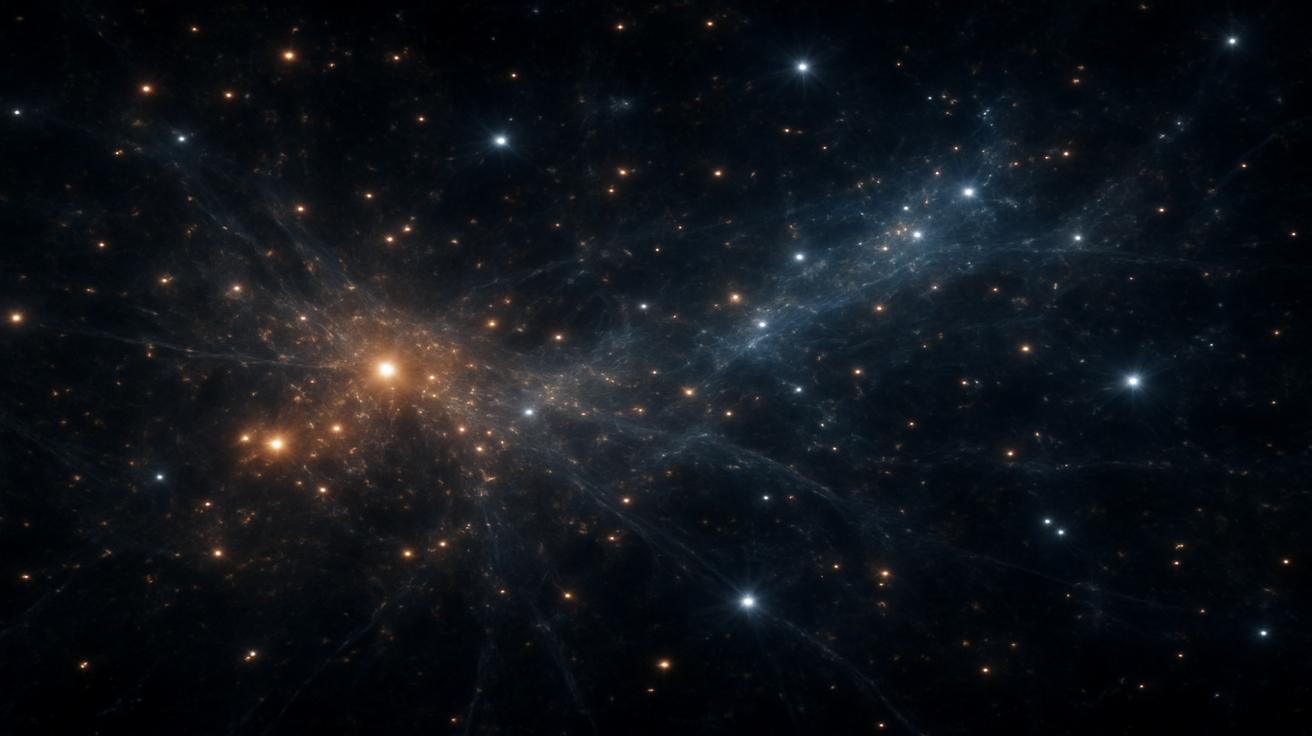
When physicists first began exploring the peculiar world of quantum mechanics in the early twentieth century, they encountered phenomena that seemed to defy logical explanation. Among these mysteries stood quantum entanglement—a process where two or more particles become mysteriously linked, instantaneously affecting one another across vast distances. What once appeared to be an exotic quirk of subatomic interactions may actually represent something far more profound: a fundamental architectural principle that weaves together every constituent particle of existence.

The Strange Foundation of Quantum Reality
Quantum entanglement emerged from decades of rigorous experimentation and theoretical refinement. When particles become entangled, measuring a property of one particle instantly determines the corresponding property of its partner, regardless of the distance separating them. Einstein famously termed this phenomenon “spooky action at a distance,” expressing his skepticism about such seemingly impossible connections.
Yet experimental evidence accumulated relentlessly. From the Bell tests of the 1980s through modern quantum computing applications, scientists confirmed that entanglement was not merely real but reproducible and measurable. However, for nearly a century, researchers compartmentalized entanglement as a peculiarity limited to carefully controlled laboratory conditions or specific particle pairs created under special circumstances.
Recent theoretical developments challenge this compartmentalized view. Some physicists now propose that we have been examining quantum entanglement through too narrow a lens, observing only isolated instances of a much grander phenomenon that permeates the entire cosmos at every scale.
From Isolated Pairs to Universal Connection
The conceptual shift begins with recognizing that our universe emerged from an extraordinarily dense, hot state approximately 13.8 billion years ago. During the first fractions of a second after the Big Bang, all particles existed in continuous proximity, their quantum states fundamentally intertwined before expansion scattered them across expanding spacetime.
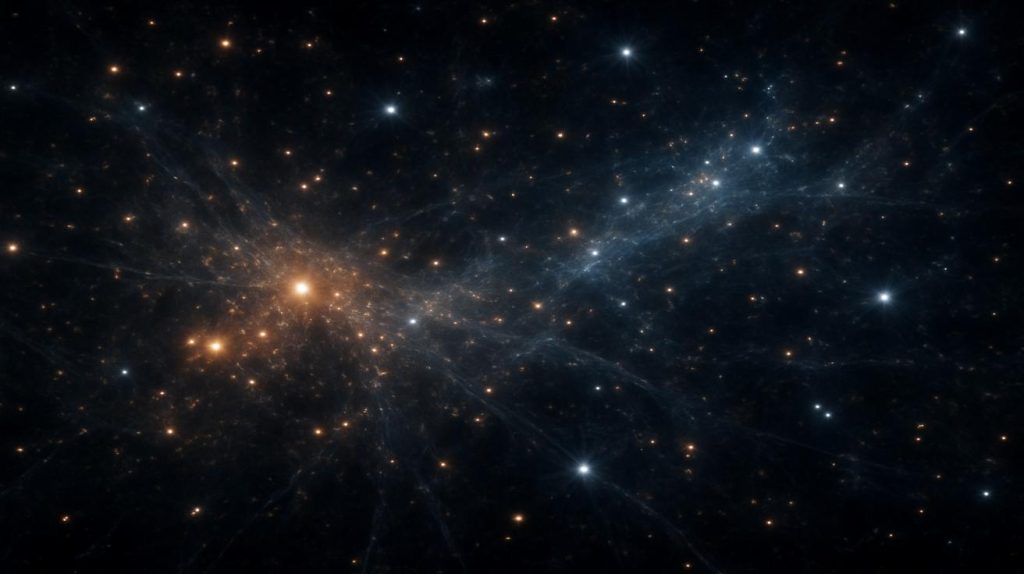
If particles retain the quantum correlations established during this primordial era, then entanglement would not represent an occasional accident requiring special creation but rather the baseline state of reality. Every electron, photon, and quark would maintain subtle connections to particles separated by billions of light-years, creating an invisible web of quantum interdependence underlying the visible universe.
This perspective transforms entanglement from an engineering tool for quantum computers into something approaching a universal operating principle. Rather than asking how entanglement occurs, scientists increasingly ask whether any particle can exist in a state that is not entangled with others.
Theoretical Implications and Mathematical Frameworks
Several theoretical frameworks now support this cosmological interpretation of quantum entanglement. Information theory approaches suggest that the universe fundamentally consists of quantum information rather than discrete particles. Under such frameworks, entanglement becomes not merely a relationship between particles but the essential medium through which reality maintains coherence and structure.
Holographic principle researchers have developed mathematical models indicating that three-dimensional spacetime might emerge from quantum entanglement patterns encoded on a two-dimensional boundary. In this view, what we perceive as spatial separation and particle individuality represents higher-dimensional projections of an entangled quantum substrate.
String theory contributions have similarly evolved toward recognizing entanglement as primary rather than secondary. Some string theorists propose that the geometry of spacetime itself—the very fabric determining distances between objects—emerges from patterns of quantum entanglement woven throughout the universe.
These mathematical systems remain speculative, but they share a common insight: entanglement might represent something far more fundamental than physicists previously imagined. Rather than occurring at the edges of quantum mechanics, it could constitute the deep structure from which all other physical laws arise.
Observational Challenges and Experimental Pathways
The primary obstacle to confirming universe-spanning entanglement lies in practical measurement limitations. Detecting entanglement between distant particles requires extraordinary sensitivity and careful elimination of environmental interference. Current technology allows us to observe entanglement effects only across laboratory distances measured in meters or perhaps kilometers using quantum satellites.
However, several experimental approaches show promise. Quantum networks currently under construction create distributed entanglement across multiple nodes separated by significant distances. These endeavors serve dual purposes: developing practical quantum communication infrastructure while simultaneously gathering data about entanglement behavior at increasingly larger scales.
Astrophysical observations present another avenue. Some researchers examine whether large-scale cosmic structures—galactic distributions, matter alignments, gravitational waves—display patterns consistent with underlying quantum entanglement. These analyses remain in early stages but have generated intriguing correlations between quantum statistical predictions and observed cosmic geometry.
Philosophical and Physical Ramifications
If universal entanglement becomes experimentally confirmed, the conceptual implications would extend far beyond theoretical physics. Such a discovery would fundamentally reframe our understanding of separation, causality, and the nature of time itself.
Classical intuitions about isolated, independent objects would require revision. Every particle would maintain genuine, non-classical connections with every other particle, suggesting that the universe operates as a single integrated whole rather than an assemblage of independent constituents. Cause and effect relationships might require reconceptualization to account for quantum correlations that appear instantaneous across space.
The philosophical implications touch metaphysical territory. Some interpretations suggest that universal entanglement supports holistic worldviews, where the fundamental nature of reality privileges interconnection over separateness. Whether such interpretations represent genuine insights or over-extrapolations remains vigorously debated among philosophers of physics.
Practical Applications and Future Research
Beyond theoretical interest, universal entanglement frameworks could reshape technological development. If entanglement patterns underlie spacetime geometry, manipulating these patterns might eventually enable novel approaches to gravitational engineering or spacetime manipulation—concepts currently confined to theoretical speculation.
More immediately, confirming entanglement at larger scales would accelerate quantum computing and quantum communication development. Understanding entanglement as a fundamental rather than exotic phenomenon could inspire new techniques for generating, maintaining, and exploiting quantum correlations.
Research institutions worldwide have begun dedicating resources to investigating entanglement at increasingly large scales. The European Quantum Flagship initiative, the U.S. National Quantum Initiative, and similar programs in China, Japan, and elsewhere include explicit objectives of understanding entanglement’s role in larger physical systems.
Remaining Questions and Skeptical Perspectives
Substantial scientific skepticism appropriately greets claims about universe-spanning entanglement. Critics rightfully note that proposals remain largely theoretical, with limited experimental support for such sweeping claims. The transition from laboratory-controlled entanglement to universal connectivity requires extraordinary evidence.
Additionally, questions persist about whether entanglement, even if universal, would possess the properties some theorists attribute to it. Decoherence—the process by which quantum systems lose coherence through environmental interaction—could potentially suppress any observable effects of cosmological-scale entanglement even if it existed.
These objections represent healthy scientific caution. Nevertheless, the convergence of multiple independent theoretical approaches toward similar conclusions has convinced many leading physicists that investigating these possibilities warrants serious effort and resources.
Conclusion: A Unified Quantum Universe
The prospect that a fundamental quantum rule might entangle the entire universe represents neither confirmed fact nor unfounded speculation, but rather a compelling research direction supported by sophisticated mathematics and consistent with established physical principles. Whether future experiments confirm this vision or reveal its limitations, the investigation promises to deepen our understanding of reality’s deepest structures.
As technological capabilities expand and theoretical frameworks evolve, the possibility that every particle in existence maintains hidden quantum connections through a universe-spanning entanglement network may transition from fascinating hypothesis to established principle. Until then, scientists continue observing, measuring, and theorizing about the possibility that beneath the apparent diversity and separation of the cosmos lies a fundamental unity—a quantum entanglement binding everything together across the vast distances of space and time.








Leave a Comment